

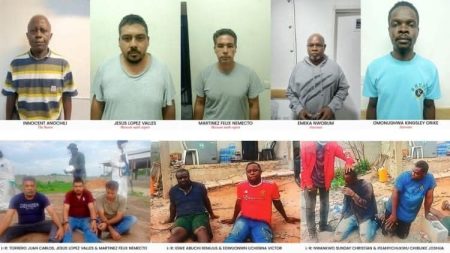
A hidden forest in Ogun State, A luxury compound in Lekki, Three Mexican “cooks,” Over 2.4 tonnes of meth and precursor chemicals, An estimated street value of ₦480 billion
By Trek Africa Newspaper
This was not just a drug bust. This was an industrial inspection of a factory Nigeria did not know it was running.
What the NDLEA walked into on 16th may 2026 and thereafter uncovered is not a story about d*ugs. It is a story about Nigeria’s quiet transformation into a manufacturing hub; not for smart phones or electronics, but for the global narc♡tics trade.
The forest was the factory. The villa was the headquarters. The Mexicans were the technical consultants. And the Nigerians? They were the hosts, the collaborators, the logistics network, and the protectors.
Deep inside Abidagba Forest in Ijebu East, Ogun State, behind the camouflage of ordinary farming activity, sat what may be the largest clandestine meth lab ever discovered in Nigeria. Not a shack. Not a backyard operation. An industrial facility, complete with precursor chemicals, industrial solvents, and laboratory equipment capable of producing methamphetamine at a scale that competes with small nations.
The alleged architect of this operation is a man named Anochili Innocent. The NDLEA calls his network the “Anochili Innocent D*ug Trafficking Organisation.” He is not a street dealer. He is not a courier. He is accused of being a systems integrator, the man who made the system work; the bridge between Nigerian money and Mexican chemistry.
And the Mexicans? They were not tourists.
Martinez Felix Nemecto, 46. Jesus López Valles, 40. Torrero Juan Carlos, 51. These are not random names. These are the fingerprints of a global criminal playbook refined by the Sinaloa Cartel and the Jalisco New Generation Cartel, groups that industrialized meth production over two decades, turning Mexico into the world’s methamphetamine capital. Now, their expertise was on lease to a Nigerian kingpin.
Because here is the uncomfortable truth the headlines miss:
Nigeria is no longer just a transit corridor for narcotics moving from Asia to Europe to the Americas. Nigeria is becoming a production zone. A manufacturing base. A place where foreign specialists are imported, rural forests are converted into chemical plants, and luxury estates in Lekki serve as command centers.
The forest was the factory. But the kingpin was not living in the forest.
On the same day operatives moved on the lab, another tactical team descended on a luxury property at No. 8 Tafawa Balewa Street, Golf Estate, Lakowe, Lekki. That is where they found Anochili Innocent. Not in hiding. Not in fear. Living comfortably. Surrounded by passports belonging to the Mexican nationals, mobile phones, and materials linking him directly to the importation and coordination of foreign operatives.
Two days later, follow-up raids hit another property in the same upscale Lekki corridor; House 70, Close 3, Mayfair Estate. Another syndicate member, Kingsley Orike Omonughwa, 44, was arrested. Another property tied to an alleged collaborator, Emeka Nwobum, was described as a “strategic stash house.”
In total: ten suspects. One alleged kingpin. Three Mexican chemists. Six Nigerian collaborators.
And the haul? According to NDLEA Chairman Brigadier General Mohammed Buba Marwa, the operation yielded 2,419.48 kilograms of methamphetamine and chemical materials; crystallized meth, liquid meth, precursor chemicals, industrial solvents. The estimated international street value: $362.9 million. Over ₦480 billion.
Let that number sit.
₦480 billion, grown quietly in a forest.
Now, watch the lazy narratives emerge. “Foreigners are destroying Nigeria.” “Mexico is invading.” These are comforting lies. Because no foreign cartel can import chemicals, move equipment, acquire land, secure safe houses, rent luxury compounds, transport industrial materials, avoid detection for months, and establish a forest laboratory without domestic collaboration.
This was not Mexico invading Nigeria. This was a joint venture. A partnership of convenience between Nigerian capital and Mexican expertise. The same model that has turned parts of Southeast Asia, Europe, and now Africa into nodes of a global synthetic drug network.
The more uncomfortable truth is this: Nigeria’s geography, its ports, its market size, its informal cash economy, its elite corruption networks, and its weak rural surveillance make it strategically attractive to transnational criminal systems. Not because Nigeria is weak. Because criminal networks are adaptive. They flow to where the enforcement is cheapest, the corruption is purchasable, and the terrain is vast.
This is not a headline. This is a diagnosis.
The forest is hidden. The villa is in Lekki. The Mexicans are in custody. But the network that enabled them? That network is still there. Still wealthy. Still corruptible. Still watching.
NDLEA won a battle. The war just showed us where the real front is.
And it is not in the forest. It is in the system that made the forest profitable… and will make the next one inevitable.
~ #EmmanuScript …✍️


