
2027 presidential campaign so far: Issues and controversies
By Trek Africa Newspaper
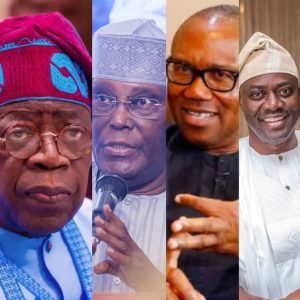
It has been 95 days since the 2027 presidential campaign kicked off and 55 days until the January 16 elections. PHILIP IBITOYE examines the strange finds en route to the all-important poll, rising political violence and intolerance, protracted legal battles, and seemingly unending opposition merger talks shaping the race so far.
WITH 55 days to the January 16, 2027, presidential election, campaigns are in top gear as 18 candidates jostle for Nigeria’s highest seat of power. Since the Independent National Electoral Commission (INEC) gave the nod for the presidential campaign to kick off on August 19, 2026, the Nigerian electorate has been treated to different political dishes, either tasty or otherwise.
Although the campaign got off to a slow start with most campaign councils not getting inaugurated until October, it has intensified in recent weeks with rhetoric rather than constructive policy statements dominating the political sphere. As the incumbent, President Bola Tinubu, defends his record and promises future prosperity, his opponents have repeatedly cast the incumbent as a failed leader who has to go for the country to have a chance at success.
But it is not only words that have defined this campaign. Nigeria has a long history of electoral violence that predates the Fourth Republic and dates back to the turbulent post-independence politics of the early 1960s. Every election cycle since the disputed federal elections of 1964 and the regional elections of 1965 has seen varying degrees of violence that result in deaths and destruction, and the 2027 campaign has been no exception.
According to the National Peace Committee’s (NPC) monitoring report, covering August 19 to October 27, there were 109 breaches of the National Peace Accord across 26 states and the Federal Capital Territory in just 10 weeks. Recall that a day before the campaign kicked off, the NPC had brought political candidates and parties together in Abuja to sign a peace accord committing them to issue-based campaigns ahead of the 2027 general election.
The candidates, belonging to various political parties, including the All Progressives Congress (APC), Nigeria Democratic Congress (NDC), Social Democratic Party (SDP), Peoples Redemption Party (PRP), Labour Party (LP), and African Action Congress (AAC), pledged to shun violence, hate speech, misinformation, personal attacks and other conduct capable of undermining the electoral process. But some major political actors, including former Vice-President Atiku Abubakar and Oyo State Governor Seyi Makinde, were conspicuously absent from the ceremony. Atiku is the presidential candidate of the African Democratic Congress (ADC), while Makinde is the presidential candidate of the Allied Peoples Movement (APM).
The ADC spokesperson, Bolaji Abdullahi, defended the party’s decision to snub the accord as a protest against what he described as the failure of the process to effectively respond to electoral violence. He argued that similar peace agreements had been signed during previous election cycles without, in the ADC’s view, sufficient action when political violence occurred.
“We’ve been signing this thing year in, year out; every election cycle, we sign in support of this commitment. Things still happen; people still get killed, harassed, like in the case of Osun, but we don’t hear the Peace Committee say anything,” Abdullahi said.
True to the ADC’s prediction, the peace accord has largely failed to forestall political violence in the past 95 days of this campaign, as the NPC’s own data has shown. In an interview with Sunday Tribune, the Head of Elections at Kimpact Development Initiative (KDI), Umar Dan’Assabe Muhammed, disclosed that the group had tracked more than 240 cases of electoral violence resulting in over 30 deaths since January 1.
“At KDI, we have been tracking pre-election violence and pre-election security generally since January 1 up to this point, and so far we have been able to track over 240 election-related violent incidents, with 31 fatalities so far,” Muhammed said.
Policy fights over economic hardship, fuel subsidy, and electricity
The presidential campaign has predictably seen plenty of fights over fuel subsidy, electricity, and the economy as the cost-of-living crisis has bitten harder, fuel prices have remained high, and poor electricity supply has persisted.
At the presidential campaign flag-off of the ruling APC in Kaduna on October 24, President Tinubu, who is seeking re-election, acknowledged that his economic and fiscal reforms had led to pains he described as temporary. But he promised that the next stage of his economic agenda is prosperity for Nigerians. The president repeated the same promise at the latest rally in Ibadan, the Oyo State capital, on Saturday, November 21.
However, Tinubu’s rivals have repeatedly dismissed his promises of economic prosperity as empty, asserting that the president cannot fix what he broke. In a statement on November 7, Atiku accused his former political ally of “creat[ing] poverty” and “insult[ing] the people suffering from it.” “You attack my Affordable Life campaign, but the people you are really attacking are the millions of Nigerians desperate for relief from your failed leadership,” the ADC presidential candidate said, promising to bring succour to Nigerians suffering economic hardship.
Similarly, Obi, who has so far favoured town halls over open-space rallies, has knocked Tinubu for allegedly plunging the country into economic hardship.
“In the last three years, President Tinubu has foisted on Nigeria a reign of corruption and duplicity, resulting in extreme poverty. Today, President Tinubu has made history as the leader who has created the largest number of poor people in the world. This year, he has made about 16 million Nigerians extremely poor,” he said on October 27 after the inauguration of his party’s presidential campaign council (PCC), while positioning himself as the candidate who can rescue the country.
The Makinde-Daura Presidential Campaign Organisation (MDPCO) has also criticised the economic policies of President Tinubu’s administration, accusing it of prioritising corporate interests and government revenues over the welfare of ordinary Nigerians. The campaign, which says it aims to “Reset Nigeria”, said an APM administration would prioritise expanded economic opportunities, fiscal discipline, and microeconomic and macroeconomic stability capable of improving the living conditions of Nigerians.
Likewise, during a TV appearance on October 26, the SDP presidential candidate, Adewole Adebayo, accused President Tinubu of failing to address poverty and insecurity, arguing that the administration has no fresh ideas to improve Nigerians’ living conditions ahead of the 2027 elections.
Another policy fight that has dominated the ongoing campaign is the one over fuel subsidy. Tinubu, who declared in his inaugural address on May 29, 2023, that “fuel subsidy is gone”, has maintained that the cost-relief programme will not return despite pump prices surging above ₦1,400 at various points since March due to the war in the Middle East. Responding to his rivals at a campaign rally in Dutse, Jigawa State, on Tuesday, November 10, the president said: “To those who say subsidy is coming back, it’s a lie. Don’t let them lie to you again. It’s not going to come back.”
However, his rivals, including Atiku and Obi, have maintained that they will bring the fuel subsidy back to relieve the pain of Nigerians.
In the same November 7 statement, the former vice-president said the president was wrong to repeatedly claim that Nigeria would never return to subsidised petrol prices. He pledged to restore “a transparent, production-based subsidy tied to the local refining of fuel.”
Obi, who had gone back and forth on reinstating and removing the fuel subsidy, has also said his administration, if elected, would return the relief regime. During a town hall meeting in Akwanga Local Government Area of Nasarawa State on Wednesday, October 28, the NDC presidential candidate also challenged the president to account for funds generated from the removal of the fuel subsidy from 2023 to date.
At a business lunch in December 2022, President Tinubu vowed to fix Nigeria’s age-long electricity supply crisis, asking voters not to re-elect him “if [I don’t give you stable electricity],” adding a caveat that, “Unless I give you adequate reasons why I couldn’t deliver.” But his time in office has seen a dramatic decline in electricity generation and distribution and he has not offered much explanation for the negative turn. In the past few weeks, distribution companies (DisCos) have often had less than 3,000 megawatts of electricity to distribute, leaving a large swathe of the country in darkness as many areas also face a heatwave.
Checks by Sunday Tribune revealed that the Distribution Load Profile for DisCos stood at 2,899.00 megawatts as of 12:32 pm on Saturday, November 21.
The deficiency has led to attacks on the president, who has barely had an answer for his critics. The Power section of the APC candidate’s manifesto, which touted some marginal gains, curiously made no future promises on electricity supply.
In a statement on November 1, Atiku accused Tinubu of failing to fulfil his campaign promise to provide Nigerians with steady electricity. The ADC candidate also pledged to abolish the existing, controversial five-band electricity system and replace it with a framework he described as fair, transparent and affordable. “President Tinubu promised steady power and an end to estimated billing. That promise has not been kept,” he said.
Obi has also seized on the president’s unfulfilled 2023 promise to deliver stable electricity and his inability to fix the electricity supply crisis, stating that Nigerians are paying higher tariffs while getting lower delivery.
Spate of political violence
The electoral violence pervading the 2027 campaign has not spared any party or candidate. On Friday, November 13, President Tinubu’s motorcade was pelted with stones by protesters. While the Federal Capital Territory (FCT) Police Command arrested 78 suspects, they were released following a presidential directive. Despite a denial of the attack by Special Assistant to the President on Digital Engagement and New Media, O’tega Ogra, the FCT police spokesperson, Josephine Adeh, confirmed the incident and said individuals suspected of being involved got “presidential clemency”.
Besides the president and his party, the NDC has faced attacks from suspected thugs in Cross River, Delta, Lagos, and Kano States in recent weeks. Similarly, the ADC campaign has suffered attacks in Sokoto State.
The violent attacks have led to finger-pointing between the political parties, with the APC PCC spokesperson and Minister of Solid Minerals, Dele Alake, accusing the dominant opposition parties – ADC and NDC – of mobilising youths to disrupt the party’s campaigns and create tension through sponsored protests, fake news and other forms of propaganda.
However, the ADC and NDC have rejected the accusations, alleging that the ruling APC introduced thuggery into the campaign. In a statement on Tuesday, November 17, the ADC PCC spokesperson, Phrank Shaibu, suggested that the APC was mistaking public dissatisfaction for opposition-sponsored hostility.
In the midst of the back-and-forth, election observers have noted a trend of free-for-all political violence that threatens to further heat up the polity. According to the KDI election expert, the electoral violence seen in recent weeks has featured counterattacks, which he described as a new pattern.
“For us, we are also seeing a new pattern that is very, very strange from what it has been before. Before now, the violence would usually be one-sided, with one political party being the frequent perpetrator always attacking the other,” Muhammed said.
“But what we are seeing now are counter-attacks and even resistance, which is making the violence even bloodier, with much more casualties and intensity in the violence. This is a new pattern that we are seeing with the 2027 tracking.”
The electoral observer also pointed to uncontrolled violent rhetoric by politicians and a lack of consequences as the forces driving the violence, calling on relevant security agencies and INEC to be more forceful in confronting actors who deploy violent language to support their parties and candidates.
The legal battles
The ADC has spent the better part of 2026 fighting unending battles over the legitimacy of the party’s leadership. In April, INEC, following a ruling by the Court of Appeal, discontinued its recognition of the leadership team led by former Senate President David Mark, throwing the party’s participation in the 2027 elections into doubt.
However, the Supreme Court arrived to save the day, restoring the legitimacy of Mark’s leadership and allowing the party to proceed with its primaries, without ruling on the merits of the case – whether Mark and his team violated the ADC constitution and Electoral Act when taking over the party in July 2025.
In June, another storm hit when Justice Peter Lifu of the Federal High Court, Abuja, ordered the deregistration of the party. However, the Court of Appeal quickly offered the party and its 1,000-plus candidates respite, rebuking Justice Lifu for ruling on a matter it had stayed.
But even that relief has not lasted. In the 95 days since the presidential campaign kicked off, Justice Lifu has thrown another spanner in the works of the opposition party, by ruling that Mark and his team illegally took over the platform in July 2025, rendering their decisions, including the nomination of the presidential candidate, Atiku, and hundreds of others, a nullity.
The ADC has appealed that decision at the Court of Appeal and is now at the mercy of the courts once again for its survival. Although INEC has maintained the status quo to allow the appeal to move forward, questions of survival continue to dog the opposition party, which aims to unseat the ruling party in 55 days.
The unresolved opposition merger question
As the opposition remains splintered, stirring memories of the 2023 elections when their division helped President Tinubu to victory with less than 37 per cent of the vote, conversations around a last-minute merger continue. Political analysts have argued that only a merger like the one that led to the creation of the APC in 2013 and its sweeping victory in 2015 can unseat an incumbent president in Nigeria.
However, that school of thought has not deterred the leading opposition candidates from running separate campaigns and refusing to coalesce behind a single force.
In an interview with Arise News on November 13, the APM presidential candidate expressed willingness to step down for either Atiku or Obi if it would help to unseat President Tinubu on January 16, 2027. But both men, who came second and third, respectively, in the 2023 presidential election, have not been as conciliatory.
In an appearance on Channels TV’s Politics Today on Thursday, November 19, the Deputy Director-General for Media and Communications of the ADC PCC, Dele Momodu, ruled out Atiku stepping down for any opposition candidate, arguing that the ADC standard-bearer has the national clout to win on his own.
Notably, the NDC has taken the same position on its presidential candidate. In a rare opposition-on-opposition attack on October 18, the party’s vice-presidential candidate, Rabiu Musa Kwankwaso, took aim at the ADC PCC for allegedly trying to mislead NDC supporters into believing that the ticket intends to withdraw in the ADC’s favour.
“We will not withdraw our candidature for the ADC or any other party. We remain confident in our capacity, competence, and readiness to lead Nigeria,” Kwankwaso said.
With just 55 days left until Nigerians head to the polls on January 16, 2027, the outcome of the race will largely depend on how these competing forces play out in the final stretch. For the ruling APC, the challenge lies in convincing weary voters that its painful economic reforms will soon translate into reliable power supply and lower living costs.
For the opposition, the test is whether it can overcome rising campaign violence, distracting courtroom battles, and deep internal divisions in time to mount a unified challenge.
Source: Tribune


