


Enugu Forest Guards: A National Model For How Governed Forests Translates To Economic Recovery – Dr. Olasoji
By Oki O. Samson, Trek Africa Newspaper

• Wins NAOSNP Award of Excellence in Forest Ecosystem Security
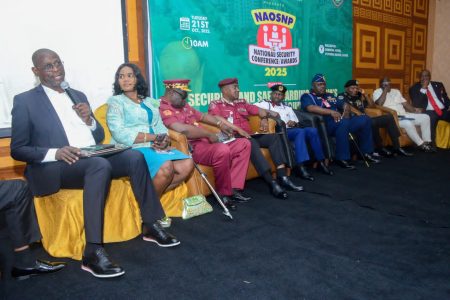
In Nigeria’s ongoing struggle with insecurity, economic fragility, and environmental degradation, one critical reality is gaining overdue attention: the country’s forests are no longer just ecological assets but strategic economic and security frontlines. From illegal mining and logging to kidnapping routes, arms movement, and violent land-use conflicts, Nigeria’s forest corridors have increasingly become theatres where insecurity incubates and national wealth quietly drains away. This intersection of security, economy, and environment dominated discussions at the recent NAOSNP National Security Conference & Awards organized by the National Association of Online Security News Publishers, NAOSNP in October 2025.
The exploits of the Enugu State Forest Guard (ESFG) established by the Executive Governor, Mr. Peter Ndubuisi Ubah presents a practical national case study for protecting Nigeria’s economic resources. This view was presented at the high-powered conference attended by top security chiefs and law enforcement officers.

Delivering a keynote address as a Special Guest Speaker at the 2025 annual NAOSNP National Security Conference and Awards titled “Securing and Safeguarding Nigeria’s Economic Resources: A Call to Serve,” the Commander of the Enugu State Forest Guards (ESFG), DCP Dr. Akinbayo O. Olasoji (Deputy Commissioner of Police, Rtd.), advanced a compelling thesis: national security must be treated as economic defence.
“A nation that cannot secure its economic resources,” he warned, “cannot guarantee prosperity, stability, or long-term peace.”
Forests Beyond Conservation: Living Economic Infrastructure
In a departure from conventional security thinking, Dr. Olasoji urged policymakers and security professionals to rethink forests not as passive green belts but as living infrastructure. According to him, forests regulate water systems, protect soils, sustain agriculture, moderate local climate, preserve biodiversity, and underpin rural livelihoods that feed urban economies.
“Forests are not just environmental assets,” he said. “They are economic systems. When they are degraded or captured by criminal activity, the economic consequences are immediate and severe.”
He listed those consequences plainly: declining farm yields, erosion and flooding, degraded water sources, displacement of rural populations, rising food insecurity, and expanding economic losses that ripple far beyond forest communities.
In a country where agriculture remains a major employer and contributor to GDP, these losses, he argued, translate directly into national economic vulnerability.
Ungoverned Spaces and the Criminal Economy
Dr. Olasoji’s keynote also confronted the uncomfortable reality that Nigeria’s forests have increasingly become ungoverned economic zones. Criminal networks, he explained, exploit difficult terrain and weak state presence to establish kidnapping routes, smuggling corridors, illegal mining sites, and arms movement channels. “Resource theft has become a financing base for instability,” he noted. “Illegal logging, illegal mining, and unlawful land occupation are no longer isolated crimes—they are economic engines for organised insecurity.”

According to him, conventional security responses often arrive too late because they are not designed for forest and eco-terrain operations. This delay allows criminal activity to mature, conflicts to escalate, and economic damage to compound.
The Enugu State Forest Guard Model
Against this backdrop, the keynote positioned the Enugu State Forest Guard Model as a deliberate attempt to reverse forest abandonment through law, structure, and professionalism. Dr. Olasoji described the Enugu State Forest Guards not as a paramilitary stopgap, but as an eco-security institution designed to restore lawful state presence across rural and forest corridors.
Central to the model is a strong legal framework anchored on the Enugu State Forest Guard Law, 2020, reinforced by the Prohibition of Open Grazing and Regulation of Cattle Ranching Law, 2021, and the Public Ranch Management Agency Law, 2024. “This legal triad is deliberate,” he explained. “It links forest protection, lawful land use, and conflict prevention into one coherent governance system.”


Under the reform agenda of Governor Peter Ndubuisi Mbah, the ESFG, he said, was transformed from a dormant structure into a professional, intelligence-led organisation with defined command architecture, accountability mechanisms, and community legitimacy.
Six Pillars That Redefine Forest Security
At the conference, Dr. Olasoji outlined six operational pillars that underpin the ESFG approach and distinguish it from ad hoc enforcement models.
The first is a mission-driven mandate. Lawful enforcement supported by intelligence-led patrols and community partnership, explicitly tied to peace and economic stability.
The second is a modern command structure, comprising a State Headquarters, eight zonal commands, 17 sector commands, and 260 ward units. This decentralised architecture ensures visibility, early warning, and rapid response at the community level.

Third is recruitment integrity, which relies on community attestation, multi-agency vetting, and biometric traceability. “You cannot secure communities with people the communities do not trust,” Dr. Olasoji said. “Credibility is operational capital.”
Fourth is training and professionalisation, built around a structured 21-day programme covering discipline, forest law, intelligence gathering, mediation, first aid, and the use of modern technology.
The fifth pillar is a clear operational doctrine, layered patrols, joint operations, reporting discipline, defined rules of engagement, and structured inter-agency coordination.
Finally, monitoring, evaluation, and transparency ensure sustainability through performance indicators, GIS and remote-sensing tools, and feedback channels that allow communities to validate outcomes.
Security, Economy, and Community Stability
According to Dr. Olasoji, the results from Enugu demonstrate a broader national lesson: “When the forest is governed, the community is safer. When the community is safer, the economy recovers.”
He argued that improved forest governance strengthens deterrence, expands actionable community intelligence, reduces violent conflict, and creates a more predictable environment for agriculture, rural trade, and lawful investment.
A Call to Build a National Eco-Security Architecture
Beyond Enugu, the keynote was a direct call for national coordination. Dr. Olasoji urged Nigeria to move from fragmented interventions to a coherent eco-security system.
Among his recommendations were a National Forest Security Framework aligned under the Office of the National Security Adviser; harmonised state Forest Guard legislation built on minimum standards; and a National Forest Security and Eco-Protection Training and Certification Centre.
He also proposed a national coordination hub for intelligence sharing, GIS mapping, and early warning, alongside youth employment programmes tied to eco-protection and restoration. “Eco-security is not only about protection,” he said. “It is also about jobs, dignity, and giving young people a stake in national stability.”
Sustainable financing, he added, could be achieved through Ecological Fund reforms and access to climate-finance windows to support equipment, welfare, and institutional continuity.
Guarding the Future
In closing, Dr. Olasoji distilled his argument into a statement that drew sustained applause:
“To defend the environment is to defend the economy. To guard the forest is to guard the future.”
As Nigeria continues to grapple with overlapping crises of insecurity, environmental stress, and economic uncertainty, the Enugu experience suggests that the path forward may lie not only in more force, but in smarter governance of the spaces where insecurity and economic loss begin.
Dignitaries in attendance at the NAOSNP National Security Conference and Awards 2025 includes; Honourable Minister of Police Affairs, Senator Ibrahim Gaidam represented by the Director of Public Affairs, MPA, Mr. Bolaji Kazeem; immediate past Chief of Defence Staff now Honorable Minister of Defence, General Christopher Gwabin Musa who was represented by Commandant of Nigerian Armed Forces Resettlement Centre, Oshodi, Air Vice Marshal, AVM Bashir R Mamman; Assistant Inspector-General of Police, AIG in charge of Zone 2, AIG Adegoke Fayoade who is also representing IGP Kayode Adeolu Egbetokun; Corps Marshal of FRSC, Mallam Shehu Mohammed represented by the Lagos Sector Commander, CC Kehinde Hamzat; Commandant-General of NSCDC, Prof. Ahmed Abubakar Audi ably represented by Commandant, NSCDC Lagos Command, Mr Keshinro Sunday; CEO/Executive Secretary of the Lagos State Security Trust Fund, LSSTF, Dr. Ayo Ogunsan represented by the Chairman of POCACOV Lagos, Dr. Moses Oladimeji; Executive Chairman of EFCC, Mr. Ola Olukoyede represented by the Head of Public Affairs, lagos EFCC, DCE Ayo Oyewole; Chairman of ICPC, Dr Musa Adamu Aliyu SAN represented by the Lagos State Commissioner, ICPC, Mr Chukwurah Alexander; Commander, Enugu State Forest Guard, Dr. DCP Akinbayo Olasoji; Commander of Ondo State Security Network (Amotekun), Amb. Akogun Adetunji Adeleye; Commander, Mining Marshals, NSCDC, ACC John Onoja Attah and CEO of Safety Signatures, Dr. Mrs. Cynthia Gregg.
Business, religious, and policy executives were also in attendance. These are the Managing Director/CEO, Smithcrown Construction Ltd, Engr. Chris Agbede; General Overseer of Mountain of Fire and Miracles Ministries (MFM), Prof. Daniel K. Olukoya, who represented by Prof Sesan Oliyide, CEO of Trans Energy E-Global, Mr. Umar Ahmed Tijani, Prophet Ikuru Godwin, Assistant Director and Head Food Technology Laboratory, Standards Organisation of Nigeria, Mrs. Arannilewa O. Comfort, Immediate Vice chairman of Orile-Agege LCDA, Hon. Kafilat T. Pedero-Akanni and CSO of Proforce Nigeria, Mr. Lawal Abiola.


