

WIMBIZ@25!!! Dangote, Hamzat, Urges Africa To Turn Resources Into Industrial Wealth
By Trek Africa Newspaper
Africa must move beyond exporting raw materials and focus on transforming its natural resources into finished products, building industries and creating wealth, Aliko Dangote, President of Dangote Group, has said.
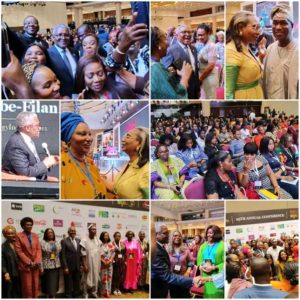
Dangote made the call at the 25th anniversary celebration of Women in Management, Business and Public Service (WIMBIZ), where business leaders, policymakers and professionals examined Africa’s economic opportunities, industrial development and women’s leadership.
Speaking on the theme: “Geography of Opportunity, Dangote argued that the continent’s abundant natural resources and human capital would remain underutilised without stronger collaboration between governments and private investors to develop local industries and retain economic value.
Using the chocolate industry as an example, he noted that although two countries account for most of the world’s cocoa production, they earn less than eight per cent of the total chocolate market value. He said this illustrated the economic disadvantage of exporting raw commodities without investing in manufacturing and finished products.
“Political freedom must be matched with economic freedom,” Dangote emphasised, calling for deliberate efforts to strengthen local production.
Drawing from his business experience, he explained how backward integration had enabled his group to move from trading to manufacturing, producing locally what was previously imported. He identified industrialization, reliable electricity, consistent government policies and access to long-term financing as critical to sustainable economic growth.
He also recounted the challenges of developing the group’s 650,000-barrel-per-day refinery, stressing that bold thinking, persistence and effective financial management were essential for executing major industrial projects. He highlighted technology and operational efficiency as important requirements for African businesses competing globally.
Meanwhile, Lagos State Deputy Governor, Dr. Kadri Obafemi Hamzat, reaffirmed the government’s commitment to expanding opportunities for women entrepreneurs through improved access to finance, mentorship and markets.
Hamzat said WIMBIZ had directly reached more than 400,000 women and indirectly impacted over five million people in its mentoring programme, he added, had benefited more than 5,600 women, with 80 per cent of participants considered ready for board appointments.
He identified access to finance as a major obstacle confronting women-owned businesses, noting that 52 per cent of women-led businesses identified financing as a significant need, compared with 30 per cent of male-led businesses. Similarly, 56 per cent of women reportedly faced high interest charges, against 17 per cent of men.
“The mothers of Lagos are the makers of Lagos,” Hamzat declared, highlighting women’s contributions to the state’s economic development.
He said the Lagos State Government was targeting at least 57 per cent female participation among beneficiaries of its enterprise programmes and seeking to increase the number of micro, small and medium enterprises from 420,000 to one million.
He also cited the Lagos State Export Readiness Programme, which has trained 253 SMEs, and the LAST EVA cooperative financing initiative, offering eligible businesses loans of up to N10 million at nine per cent annual interest without conventional collateral.
On the organisation’s 25-year journey, Bennedikter Molokwu, Corporate Governance Professional and Conference Chairperson, described the anniversary as an opportunity to consolidate achievements and prepare for emerging economic challenges.
Under the theme: “Rooted, Rising, Ready,” Molokwu said the organisation’s African identity, professional expertise and collective experience had helped members navigate economic recessions, currency fluctuations, policy changes and the COVID-19 pandemic.
She described the theme as “a strategic blueprint for organisational evolution,” emphasising collaboration and shared responsibility in advancing women’s leadership. She noted that members had progressed into chief executive positions, technology entrepreneurship, banking leadership and public service.
In another session, Sahara Group Co-Founder and Executive Director, Tope Shonubi, explained that successful business expansion depended on knowing when to build infrastructure, acquire existing assets or partner with other investors.
He cautioned that infrastructure investments must be supported by adequate market access, citing a Nigerian power plant with 180 megawatts of available capacity but only 10 to 15 megawatts that could be evacuated because of limitations in the national grid.
“Building infrastructure allows you to architect your destiny, but you must understand the ecosystem within which that infrastructure will operate,” he said.
Shonubi also highlighted the risks associated with acquisitions, stressing the importance of thorough due diligence before committing capital. He cited Sahara’s minority investments in refineries in Senegal and Cameroon, alongside investments in Gabon, as examples of partnerships that provide market access without the enormous financial requirements of full ownership.
Earlier WIMBIZ BoT Chair, Mrs. Ebisan Akisanya, gave a heartfelt welcome — describing WIMBIZ as not just an organization but a movement and an unshakable force that has, for 25 years, inspired women to live with courage, authenticity, and purpose. Her words set the tone for a day that reminded participants all to keep growing, learning, and giving back.
On his part Ogun State Secretary to the State Government, Tokunbo Talabi, urged professionals to prepare for retirement by developing businesses, building networks and establishing alternative income streams before leaving paid employment.
Talabi warned that professionals who depend entirely on salaries risk financial difficulties after retirement. He encouraged workers to overcome psychological barriers to entrepreneurship, learn from business failures and concentrate on ventures with clear market demand.
“Staying static is dangerous because a lack of growth eventually leads to decline,” he said. He advised professionals to leverage their existing expertise in law, engineering, banking and corporate administration to develop consulting and other businesses, while building relationships that could generate opportunities after retirement.
The anniversary celebration underscored the importance of industrial investment, inclusive economic policies, strategic partnerships and professional development in advancing Africa’s competitiveness. Speakers agreed that the continent’s ability to translate its resources, talent and entrepreneurial ambition into productive wealth would determine its long-term prosperity.


